





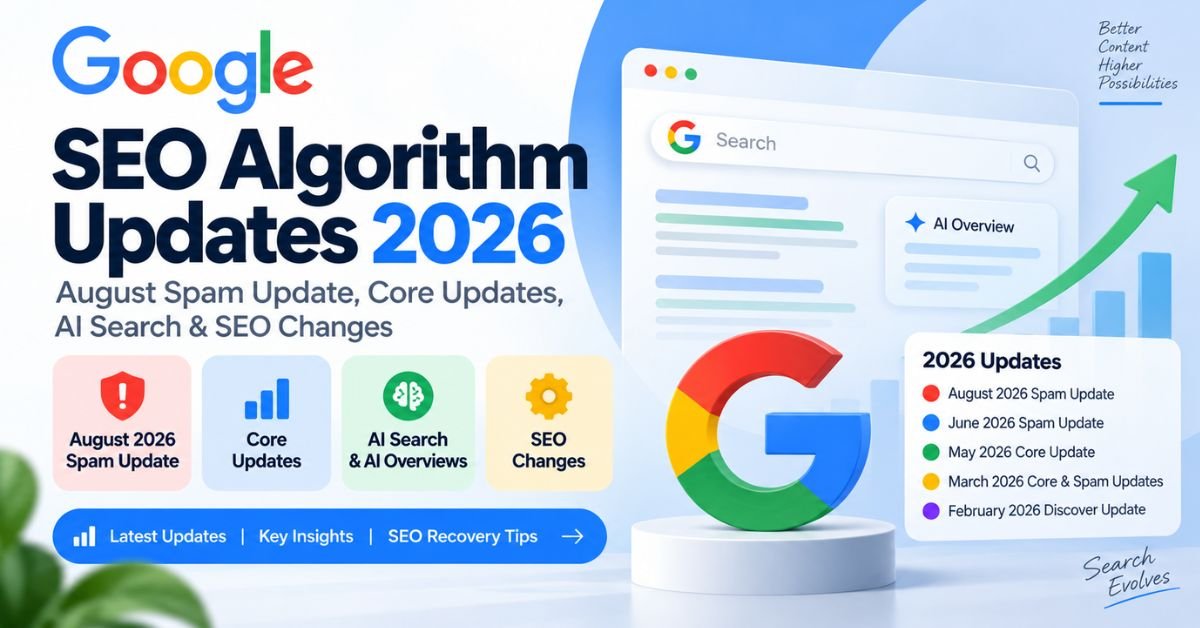
Google Algorithm Updates 2026: August Spam Update, Core Updates, AI Search & SEO Changes
Google Search continues to evolve throughout 2026 with major spam updates, core algorithm changes, Discover updates, AI-powered search experiences and changes to Search features. For SEO professionals, publishers and website owners, understanding what changed—and distinguishing confirmed Google updates from normal ranking volatility—is more important than ever.
Table of Contents
- Google Algorithm Updates in 2026
- Google Search Status Dashboard
- August 2026 Spam Update
- June 2026 Spam Update
- May 2026 Core Update
- March 2026 Core and Spam Updates
- February 2026 Discover Update
- AI Search, AI Overviews and AI Mode
- Content Quality and AI-Generated Content
- Scaled Content Abuse
- Site Reputation Abuse
- Google Entertainment Review Profiles
- Seeing a Drop in Organic Visits? What to Do
- How the 2026 Updates Can Affect SEO
- SEO Strategy for the Rest of 2026
- Why Choose Dudes Creative?
- Frequently Asked Questions
Google Algorithm Updates in 2026
Google has confirmed several major ranking-related updates during 2026, including spam updates, core updates and a Discover update. These updates do not all work in the same way.
A core update generally involves broader changes to Google's ranking systems, while a spam update focuses on Google's systems for detecting and addressing spam. A Discover update affects the systems used to determine content shown through Google Discover.
According to Google's official Search Status Dashboard, the confirmed 2026 ranking history includes the February Discover update, March spam and core updates, the May core update, the June spam update and the August spam update.
| Google Update | Type | Start Date | Duration |
|---|---|---|---|
| August 2026 Spam Update | Spam | August 18, 2026 | 2 days, 16 hours |
| June 2026 Spam Update | Spam | June 24, 2026 | 2 days, 1 hour |
| May 2026 Core Update | Core | May 21, 2026 | 11 days, 21 hours |
| March 2026 Core Update | Core | March 27, 2026 | 12 days, 4 hours |
| March 2026 Spam Update | Spam | March 24, 2026 | 19 hours, 30 minutes |
| February 2026 Discover Update | Discover | February 5, 2026 | 21 days, 17 hours |
Google's official ranking history can be checked at Google Search Status Dashboard – Ranking History .
Track Google Updates on the Search Status Dashboard
The Google Search Status Dashboard should be one of the first places SEO professionals check when significant ranking changes appear.
Google uses the dashboard to publish confirmed ranking updates and maintain a history of important Search changes. SEO teams can compare this information with Google Search Console, Google Analytics and third-party rank-tracking data.
This distinction is important because SEO tools can report significant SERP volatility even when Google has not confirmed a specific core or spam update.
Do not automatically assume that every ranking fluctuation is caused by a Google algorithm update. Check the official update timeline first, then investigate your own website, competitors and technical SEO.
August 2026 Spam Update
Google's August 2026 Spam Update began on August 18, 2026 and finished on August 21, 2026. Google's Search Status Dashboard records the rollout as lasting 2 days and 16 hours.
The update was classified as a spam update and applied globally across all languages. It was the third confirmed spam update released by Google during 2026, following the March and June spam updates.
Google did not announce a new spam policy specifically for the August rollout. Website owners should therefore review Google's existing Search spam policies instead of trying to identify a secret "August update ranking factor."
If your website lost visibility during the rollout, that does not automatically mean Google assigned your domain a literal "spam score." Google uses multiple automated systems and signals to evaluate content, spam and search quality. A traffic decline may indicate that your pages were reassessed, competitors gained visibility, search intent changed, or your website has quality or technical issues that need attention.
What Should You Check?
- Scaled or mass-produced content
- Thin or outdated pages
- Scraped, copied or lightly rewritten content
- Doorway pages
- Keyword stuffing
- Spammy user-generated content
- Manipulative redirects or other deceptive practices
- Unnatural internal or external linking patterns
- Unhelpful third-party content published mainly for SEO benefits
Read: Google Search Spam Policies .
June 2026 Spam Update
The June 2026 Spam Update began on June 24, 2026 and completed on June 26, 2026. Google's official dashboard records a duration of 2 days and 1 hour.
Like the August update, the June rollout was classified as a spam update and applied globally across all languages.
If a website experienced a traffic or ranking decline during this period, the appropriate response was to review the website against Google's existing spam policies and evaluate the affected pages rather than assuming the entire website had received a manual penalty.
May 2026 Core Update
The May 2026 Core Update started on May 21, 2026 and completed on June 2, 2026. Google's Search Status Dashboard records a total duration of 11 days and 21 hours.
A core update is different from a spam update. Core updates involve broader changes to Google's ranking systems and can affect how Google evaluates relevance, usefulness and quality across many types of searches.
A ranking decline following a core update does not necessarily mean that a website violated a Google policy. A page can lose visibility because Google's systems determine that other pages are more relevant, useful or satisfying for a particular search.
Questions to Ask After a Core Update
- Does the page provide original information?
- Does it fully satisfy the user's search intent?
- Does it demonstrate appropriate expertise or first-hand experience?
- Is the information accurate and up to date?
- Does the page provide more value than competing results?
- Is the content primarily written for people rather than search engines?
- Does the website have a clear purpose and topical focus?
Learn more: Google's guidance on helpful, reliable, people-first content .
March 2026 Core and Spam Updates
March 2026 was particularly active for Google Search, with a spam update followed shortly afterward by a core update.
March 2026 Spam Update
The March 2026 Spam Update began on March 24 and lasted approximately 19 hours and 30 minutes.
March 2026 Core Update
The March 2026 Core Update began on March 27 and continued for approximately 12 days and 4 hours.
Because the two updates occurred close together, websites analyzing historical traffic from March should avoid attributing every change to one particular ranking system.
Segmenting Search Console data by query, URL, country and device can help identify whether the change was broad or concentrated around particular parts of a website.
February 2026 Discover Update
Google's February 2026 Discover Update began on February 5 and lasted approximately 21 days and 17 hours.
Google Discover is different from traditional Search because users do not necessarily enter a search query before seeing content. Discover therefore has its own traffic patterns and can behave differently from normal organic search.
Publishers that receive substantial traffic from Discover should monitor Discover performance separately from standard Web Search traffic.
AI Search, AI Overviews and AI Mode in 2026
Google's algorithm updates are only one part of the SEO landscape in 2026. The search results page itself is changing as Google expands AI-powered experiences.
AI Overviews and AI Mode can provide users with synthesized information and links to supporting sources. This changes how websites can receive visibility from Google.
Traditional blue-link rankings remain important, but SEO reporting increasingly needs to consider a broader set of visibility signals, including impressions, clicks, branded searches, mentions, citations and qualified traffic.
The SEO Shift
The objective is no longer simply to rank for a keyword. Strong SEO increasingly means creating information that is useful enough to be selected, referenced, trusted and visited across multiple Google search experiences.
Content Quality and AI-Generated Content
One of the biggest SEO misconceptions in 2026 is that Google automatically penalizes every piece of content created with artificial intelligence.
Google's guidance does not state that using AI is automatically against its Search policies. The more important question is why the content was created and whether it provides real value to users.
AI can be useful for research, brainstorming, outlining, summarization and drafting. However, simply generating thousands of pages and publishing them without meaningful review, originality or usefulness can create significant SEO risks.
Strong AI-Assisted Content Should Include
Scaled Content Abuse: Why Mass Production Can Become an SEO Problem
Google's spam policies include scaled content abuse, which concerns the creation of large amounts of content primarily to manipulate Search rankings rather than provide value to users.
This can involve automatically generated content, scraped content, heavily rewritten material or other techniques that produce many pages without sufficient original value.
The important distinction is not simply whether automation was used. The key issue is whether the resulting content is useful, original and created for people.
Generate thousands of pages around every possible keyword variation and publish them with little original information.
Better approach:Use automation where it improves efficiency, but add genuine research, expertise, original data, useful examples and human quality control.
Site Reputation Abuse Remains an Important SEO Issue
Google's site reputation abuse policy remains important for publishers that host third-party content.
The concern is when third-party content is published on an established website primarily to take advantage of the host site's existing ranking signals.
For example, a website with strong authority in one subject might suddenly host large amounts of unrelated third-party content because the third party wants to benefit from the domain's existing visibility.
However, third-party content is not automatically a violation. Legitimate editorial partnerships, appropriate user-generated content and other genuine uses can be acceptable depending on the circumstances.
Questions Publishers Should Ask
- Does this content genuinely belong on our website?
- Is the topic relevant to our audience?
- Are we publishing it because it helps users?
- Would we publish this content if Google rankings did not exist?
- Do we maintain genuine editorial control?
- Does the content meet the same quality standards as our own content?
Google Search to Remove Entertainment Review Profiles
Another notable Google Search change in 2026 concerns the retirement of entertainment review profiles.
Google previously allowed users to submit reviews for entertainment content such as movies and television shows through Google Search. These contributions were associated with profiles that allowed users to manage their entertainment reviews.
Google has now stopped showing these entertainment reviews in Search and is discontinuing the associated profiles.
According to the information reported by Dudes Creative, these entertainment review profiles will no longer be active after September 12, 2026.
Users who want to preserve their previous entertainment reviews and profile information can download their data through Google Takeout until October 12, 2026.
This change should not be confused with Google's review system for businesses. Entertainment review profiles are a separate feature from reviews associated with businesses, restaurants, hotels and local services.
Seeing a Drop in Organic Visits? Act Now Before the Problem Gets Worse
If your website has experienced a noticeable decline in organic visits, rankings, impressions or leads after a Google update, do not simply wait and hope that traffic returns.
A traffic decline does not automatically mean that Google has assigned your domain a specific spam score. Google does not publish a single domain-level "spam score" that website owners can check. However, a sustained decline—especially when it coincides with a spam update—can be a reason to perform a comprehensive SEO audit and determine whether your website has content-quality, spam, technical or relevance problems.
Do Not Ignore a Sustained Traffic Drop
If organic visits continue falling, delaying an SEO audit can make it harder to identify the original cause. Review the website, remove obvious low-value content, improve weak pages and correct technical problems as quickly as possible.
Step 1: Remove Dummy, Placeholder and Unnecessary Content
Start by reviewing the entire website for dummy content, placeholder text, automatically generated filler pages, empty category pages, thin tag pages and pages that provide little practical value.
If a page exists only because someone wanted to target another keyword, but it does not provide a useful experience for visitors, consider whether it should be substantially improved, consolidated or removed.
- Remove placeholder or dummy text.
- Remove unnecessary empty pages.
- Consolidate duplicate or overlapping articles.
- Improve thin pages with useful information.
- Remove pages created solely for keyword variations when they have no independent value.
- Review old content that is no longer accurate or useful.
Step 2: Update Short or Thin Content
Short content is not automatically bad. A concise page can rank well if it completely satisfies the user's intent. The problem is thin content that fails to answer the visitor's question or provide enough useful information.
Instead of adding unnecessary words simply to increase word count, improve the page with original information, examples, specifications, expert explanations, FAQs, comparisons, images, tables and relevant supporting resources.
Step 3: Review Internal Linking
Check your internal linking structure carefully. Important pages should be discoverable through logical links from relevant pages across the website.
- Link related articles to one another naturally.
- Link informational content to relevant service or product pages.
- Use descriptive anchor text instead of excessive generic anchors.
- Make sure important pages are not isolated.
- Fix broken internal links.
- Avoid excessive internal links that make pages difficult to read.
- Build logical topical clusters around important subjects.
Step 4: Audit Schema Markup
Review the website's structured data and make sure the schema accurately represents the visible content on each page.
- Check Organization or LocalBusiness schema where appropriate.
- Validate Article and BlogPosting markup.
- Review Product schema on product pages.
- Check BreadcrumbList implementation.
- Review FAQPage markup where it is genuinely appropriate.
- Remove duplicate schema generated by multiple plugins.
- Fix invalid or misleading structured-data properties.
- Make sure structured data does not describe content that is not visible to users.
Schema markup should support accurate understanding of the page; it should not be treated as a shortcut for ranking improvements.
Step 5: Perform a Complete Technical SEO Audit
A content audit alone is not enough. Technical SEO problems can prevent Google from properly crawling, indexing and understanding your website.
Step 6: Check Titles, Meta Descriptions and On-Page SEO
Review important pages for duplicate titles, missing meta descriptions, keyword stuffing, weak headings and poor search-intent alignment.
Every important page should have a clear purpose. The title, main heading, supporting headings, body content, images and internal links should work together to satisfy the visitor rather than simply repeating the target keyword.
Step 7: Review External Links and Backlinks
Review both the links your website publishes and the backlink profile pointing to your domain. Look for obvious spam, manipulative patterns, irrelevant link schemes and suspicious SEO campaigns.
Do not blindly remove legitimate backlinks or use Google's disavow tool simply because a third-party tool labels a link as "toxic." Backlink analysis requires context and careful evaluation.
Step 8: Check Google Search Console
Google Search Console should be one of your primary diagnostic tools after a traffic decline.
- Compare clicks before and after the update.
- Compare impressions and average position.
- Identify queries that lost visibility.
- Identify URLs that lost clicks.
- Check indexing and crawl reports.
- Review Core Web Vitals.
- Check for security issues or manual actions.
Step 9: Review Content Depth and Search Intent
Compare pages that lost rankings against the pages currently ranking above them. Look beyond word count and examine whether competing pages provide better answers, stronger evidence, clearer explanations, original examples or a better overall experience.
If your page is targeting a commercial query, make sure it actually helps users make a decision. If it targets an informational query, make sure it answers the question clearly and completely. Search intent should determine the structure and purpose of the page.
Step 10: Fix the Problems as Soon as Possible
Once the causes are identified, prioritize the fixes. Start with serious technical problems, spam-policy risks, dummy or low-value content, major indexing issues and pages that are important to your business.
Do not make hundreds of unrelated changes at once without documentation. Keep a record of significant changes so you can measure whether the website improves after the work is completed.
SEO Recovery Checklist
If organic traffic is falling, review these areas as soon as possible:
- Remove dummy and unnecessary content.
- Improve thin and outdated pages.
- Fix duplicate and cannibalized content.
- Improve internal linking.
- Validate schema markup.
- Check indexing and canonicalization.
- Fix technical SEO errors.
- Review page speed and Core Web Vitals.
- Check Search Console for indexing or manual-action issues.
- Review spam-policy compliance.
- Compare affected pages with current competitors.
- Monitor rankings and organic traffic after improvements.
How the 2026 Updates Can Affect SEO
The impact of a Google update can vary significantly from one website to another. Two websites in the same industry can experience completely different outcomes because their content, authority, technical setup, competition and search intent differ.
Some websites may gain rankings while others lose visibility. This is one reason why SEO professionals should avoid describing every update as a simple "penalty."
Core Updates
Can change the relative visibility of content across many search queries.
Spam Updates
Focus on detecting and addressing behavior covered by Google's spam policies.
Discover Updates
Can affect visibility and traffic generated through Google Discover.
AI Search
Changes how users discover and interact with information in Google.
SEO Strategy for the Rest of 2026
Google's 2026 updates suggest that long-term SEO success will depend less on manipulating individual ranking signals and more on building websites that consistently provide useful information.
Build Topical Authority
Create genuinely useful resources around subjects your website is qualified to cover.
Add Original Information
Use original research, examples, testing, statistics, photographs, case studies and expert commentary.
Use AI Responsibly
Use AI to improve efficiency without turning your website into a large collection of generic pages.
Improve User Experience
Make content easy to read, navigate and understand on both desktop and mobile devices.
Strengthen Technical SEO
Maintain crawlability, indexability, canonicalization, internal linking, performance and structured data.
Monitor Search Changes
Track confirmed Google updates and compare them against Search Console and analytics data.
SEO Is Moving Beyond Keywords
Keywords remain important, but modern SEO requires a broader understanding of search intent, entities, topical relevance, content quality, user experience and information satisfaction.
With AI-powered search becoming more prominent, websites should also focus on creating information that can be clearly understood and trusted by both users and search systems.
Need Help Recovering Your Google Traffic?
If your website has lost organic visits, rankings or search visibility, Dudes Creative can help you identify potential problems and build a practical SEO recovery strategy.
Why Choose Dudes Creative for SEO, Technical SEO & Web Development?
SEO recovery is rarely limited to writing more content. A website may need improvements across content, technical SEO, structured data, internal linking, website architecture, performance and development.
Dudes Creative can assist businesses that need a combination of SEO, technical SEO, website development, content optimization and search visibility improvements.
SEO Strategy
Practical SEO strategies based on your website, industry, competitors, search intent and business objectives.
Technical SEO
Technical audits covering crawling, indexing, canonicalization, redirects, schema, site architecture and performance.
Content Optimization
Improve thin, outdated or unhelpful content and develop pages that better satisfy users and search intent.
Web Development
Development support for WordPress and modern websites where technical implementation affects SEO performance.
Schema & Structured Data
Implementation and troubleshooting of relevant structured data while avoiding duplicate or misleading markup.
Affordable SEO Support
SEO and development assistance with practical solutions designed around the website's actual needs and budget.
Looking for an SEO Service Provider?
Contact Dudes Creative. We would be more than happy to discuss your website, identify potential SEO and technical issues, and recommend a practical solution at a reasonable price range.
Frequently Asked Questions About Dudes Creative SEO Services
Why should I choose Dudes Creative for SEO services?
Dudes Creative takes a broader approach to SEO by looking beyond keywords and backlinks. Our approach can include technical SEO, content optimization, internal linking, structured data, website architecture, performance and development where required. The objective is to identify the actual problems affecting search visibility and address them systematically.
Can Dudes Creative help if my website suddenly lost Google traffic?
Yes. We can review the timing of the traffic decline, Google Search Console data, affected URLs, search queries, technical SEO, content quality, internal linking and other relevant areas. The first step is diagnosis rather than making random changes that could make the situation worse.
Does Dudes Creative provide technical SEO services?
Yes. Technical SEO can include crawling and indexing analysis, robots.txt, XML sitemaps, canonical URLs, redirects, website architecture, internal linking, structured data, Core Web Vitals, mobile performance, JavaScript-related issues and other technical factors that can affect search visibility.
Can Dudes Creative help with website development as well as SEO?
Yes. Website development can be particularly useful when an SEO problem requires changes to the site's underlying implementation. Dudes Creative can assist with website development and SEO-focused improvements so that design, functionality and search performance work together rather than being treated as separate projects.
Can Dudes Creative fix schema and structured-data problems?
Yes. We can review existing schema implementation, identify duplicate or conflicting structured data, correct relevant markup and ensure that schema is aligned with the actual content and purpose of the page. Structured data should be accurate and implemented according to Google's guidelines.
How can I contact Dudes Creative for SEO or web development?
You can contact Dudes Creative to discuss SEO, technical SEO, website development, content optimization or a Google traffic recovery project.
Email:
info@dudescreative.com
Mobile:
+91 60097 61566
Website:
www.dudescreative.com
Official & Recommended Resources
Don't Wait Until the Traffic Drop Gets Bigger
If your website has lost Google visibility, get the problem reviewed and take corrective action as soon as possible.
Contact Dudes Creative +91 60097 61566