





Google Search Console Update 2026
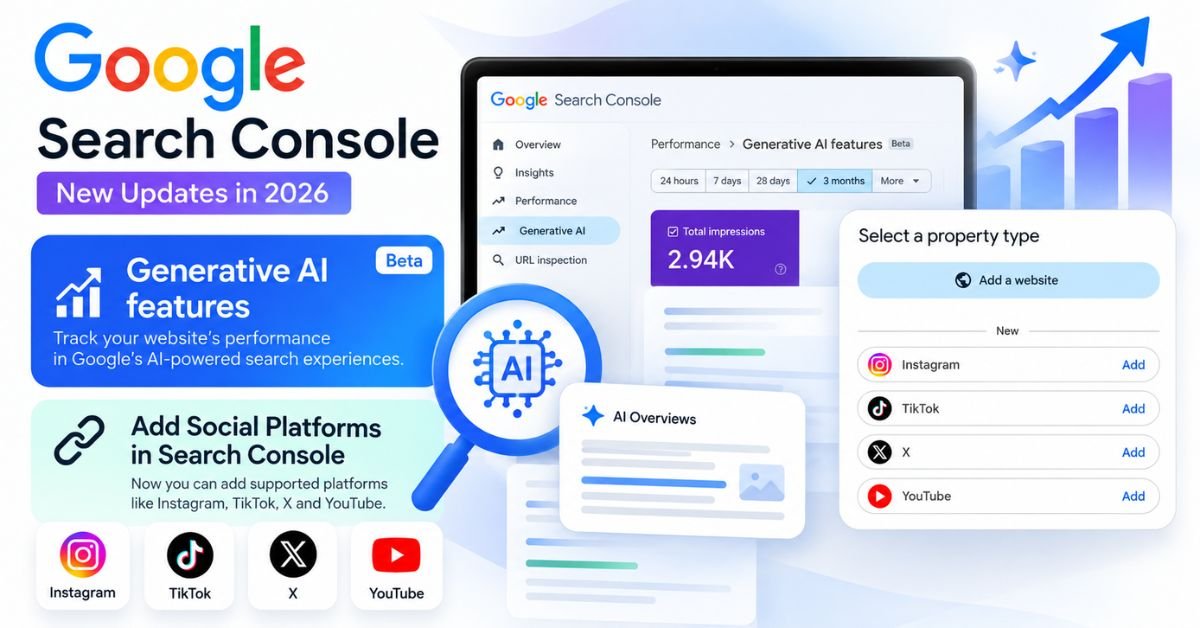
Google has expanded Search Console with a new Generative AI performance report and new platform-property options for supported social and content platforms.
What Is the New Generative AI Feature in Google Search Console?
Google Search Console continues to expand beyond traditional website search reporting. In 2026, Google introduced a new Generative AI performance report that gives eligible website owners more visibility into how their pages appear in Google's supported generative AI search experiences.
The report is particularly relevant as Google Search increasingly incorporates AI-powered experiences. Google's official documentation identifies AI Overviews and AI Mode as supported generative AI features in the reporting.
This is different from the standard Search Console Performance report. Traditional reporting focuses on search performance such as clicks, impressions, click-through rate, average position, queries, pages, countries, and devices. The Generative AI report provides an additional view of visibility generated through supported AI search experiences.
What Does a Generative AI Impression Mean?
One of the most important concepts to understand is the meaning of an impression in the new report.
Google explains that a generative AI impression is associated with a link to your website being shown to a user in a supported generative AI feature on Google Search.
For example, if Google generates an AI-powered response to a user's query and includes a link to one of your pages, that visibility can contribute to the site's Generative AI impressions.
Impression does not automatically mean click.
AI search experience → Your page is shown as a supporting link → Impression
AI search experience → Your page is shown → User selects the link → Click
This distinction matters when measuring AI-search visibility. A website may gain exposure in AI-powered results even when the user does not click through to the site.
The Generative AI Report in Search Console
According to Google's official Search Console documentation, Generative AI performance insights were rolled out globally on August 31, 2026. Google also notes that availability can depend on eligibility and rollout conditions.
If a property has enough eligible impressions from supported generative AI features, the report can provide useful information about AI-related search visibility. A website may not see meaningful data if it has not received sufficient impressions from supported generative AI experiences.
For SEO teams, this creates a new reporting layer alongside traditional Search Console data. Instead of measuring only conventional search performance, marketers can begin examining how their content performs within Google's evolving AI search environment.
What Can You Analyze in the Generative AI Report?
1. Pages
The Pages dimension can help identify which URLs receive impressions from supported generative AI features.
This can reveal whether AI visibility is concentrated around:
- Product pages
- Technical guides
- Blog articles
- Category and service pages
- Documentation
- Informational resources
2. Countries
Country-level reporting is especially useful for international SEO. Businesses targeting markets such as the United States, United Kingdom, United Arab Emirates, Canada, Australia, or India can evaluate where their generative AI visibility is coming from.
3. Devices
Device information can help SEO professionals compare AI-related visibility across desktop, mobile, and tablet search experiences.
4. Dates
Date-based reporting makes it possible to monitor trends over time. SEO teams can compare AI visibility before and after significant content updates, technical changes, or broader changes in Google's search experience.
Google Adds Social and Platform Properties
Another notable Search Console development in 2026 is the introduction of platform properties. Google is expanding Search Console beyond traditional websites by allowing supported creator and publisher platforms to be added as properties.
Google's current documentation lists supported platforms including:
- TikTok
- X
- YouTube
The new property selector can therefore give creators and publishers another way to monitor how eligible content from supported platforms performs in Google Search.
What Are Platform Properties?
A platform property represents a supported presence on a content or social platform. For example, depending on eligibility and Google's rollout, a creator may add a supported Instagram, TikTok, X, or YouTube presence to Search Console.
The purpose is not to turn Search Console into a complete social-media analytics system. Instead, Google uses Search Console to provide information about how eligible platform content performs in Google Search.
Search Console Does Not Replace Social Analytics
This distinction is important for marketers and creators.
If you publish a video on YouTube, YouTube Analytics remains the appropriate source for detailed YouTube performance. Search Console can provide information about eligible visibility when that content appears in Google Search.
The same principle applies to Instagram, TikTok, and X. Search Console should be viewed as a Google Search visibility layer, not as a replacement for native social-platform analytics.
Why Is This Important for SEO?
Search behavior is no longer limited to traditional blue links. Google Search now includes multiple content formats and experiences, including web results, images, videos, Discover content, AI Overviews, AI Mode, and content from supported platforms.
This creates a broader search ecosystem for brands. A business may have a website, YouTube channel, Instagram presence, TikTok account, and X profile. Each can contribute to the brand's overall digital footprint, while Search Console increasingly provides ways to understand eligible visibility within Google Search.
For SEO professionals, this means that search performance should increasingly be evaluated beyond a single ranking position.
Generative AI and Generative Engine Optimization
Generative Engine Optimization (GEO) is a term used in the SEO industry to describe efforts to make content clearer, more useful, authoritative, and machine-understandable for generative AI systems and AI-powered search experiences.
However, GEO should not be confused with an official Google ranking factor or a special piece of markup that guarantees inclusion in AI-generated answers.
Google's Search documentation continues to emphasize strong fundamentals. Websites should focus on useful and original content, clear organization, crawlability, indexability, good user experience, appropriate structured data, and accurate information.
For businesses, a practical GEO strategy can include:
- Creating original, useful content
- Answering specific user questions clearly
- Building topical authority
- Using relevant structured data correctly
- Maintaining consistent business and product information
- Building strong internal links and logical content relationships
- Demonstrating expertise and trust
Google's Search Generative AI Control
Google has also documented a Search generative AI control that allows site owners to manage whether their site's links and content can appear in certain Google Search generative AI features.
Google's documented options include:
- Include my site's links and content in Search generative AI features
- Exclude my site's links and content from Search generative AI features
- Inherit control from parent
For publishers that want their content to remain eligible for Google's generative AI search experiences, it is important to understand this setting before changing it.
Should SEO Professionals Monitor the Generative AI Report?
Yes. The report creates another data source for understanding how Google exposes a website within its evolving search ecosystem.
An SEO team could monitor:
Website pages → AI impressions → Countries → Devices → Dates
Then compare those trends against traditional Search Console performance:
Clicks → Impressions → CTR → Average position → Queries
This creates a broader picture of search visibility. Instead of asking only, "How many keywords are ranking?", SEO professionals can also ask, "How is our content being discovered across Google's different search experiences?"
Search Console Is Becoming More Than a Traditional SEO Tool
Historically, SEO professionals primarily used Search Console for queries, rankings, clicks, impressions, CTR, indexing, sitemaps, and page-level diagnostics.
Google's newer reporting capabilities show that Search Console is evolving alongside Google Search itself. Websites, videos, Discover content, supported social-platform content, and AI-powered search experiences can all contribute to a modern brand's search visibility.
The combination of web properties + Generative AI reporting + platform properties gives publishers and SEO professionals a wider framework for understanding search performance.
Final Thoughts
Google's introduction of Generative AI reporting in Search Console is an important development for SEO in 2026. The new report provides website owners with additional visibility into impressions generated through supported Google Search AI experiences, including AI Overviews and AI Mode.
At the same time, Google's platform-property functionality expands Search Console beyond traditional website properties by supporting platforms such as Instagram, TikTok, X, and YouTube as eligible properties during Google's rollout.
These changes reflect a broader evolution of Google Search. Search visibility is no longer only about where a webpage ranks in a traditional results page. It can also involve AI-generated experiences, video, Discover, and content published across supported platforms.
The practical SEO lesson is simple: continue building technically sound websites and useful, original, well-structured content, while also monitoring how that content performs across Google's evolving search experiences.
Official Google Documentation
This article was prepared for DudesCreative.com using Google's official Search Console documentation as the primary reference. It does not rely on third-party SEO blog articles.