





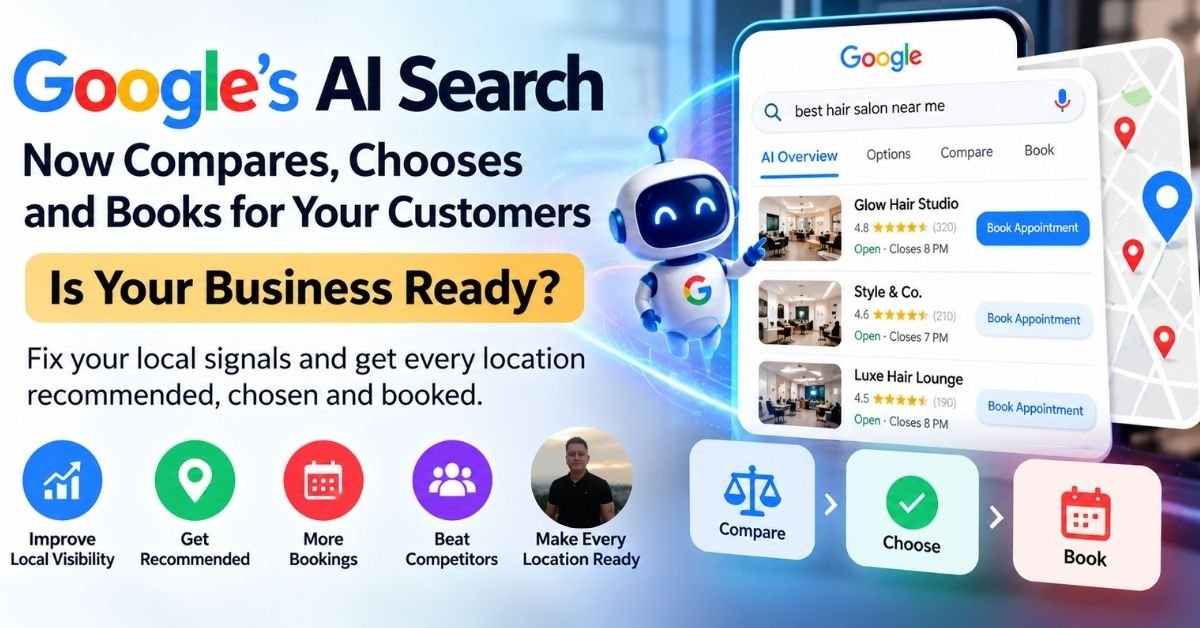
Google AI Search & Local SEO: Get Your Business Recommended & Booked - Google AI Search Is Changing Local Discovery: How Businesses Can Get Recommended, Chosen and Booked
Local search is moving beyond traditional rankings. Google's AI-powered experiences can understand questions, compare information and increasingly help people take action. Here's how businesses can prepare every location for this new search environment.
Table of Contents
- How AI Is Changing Local Search
- Why Traditional Local SEO Is No Longer Enough
- The Local Signals AI Uses to Understand a Business
- Why Every Location Needs Its Own Optimization
- How to Build Content AI Can Understand
- Reviews and Reputation as AI Discovery Signals
- Where Booking Fits Into AI Search
- What AI May Compare Before Recommending a Business
- Five Local SEO Fixes to Make Now
- The Multi-Location AI Search Checklist
- The Future of Local Search
- Frequently Asked Questions
- Conclusion
How AI Is Changing Local Search
For years, local SEO followed a relatively familiar process. Someone searched for a service, Google displayed local businesses, and the customer selected a company to visit, call or contact.
That journey is becoming increasingly conversational.
Instead of searching for a short phrase such as "dentist near me" or "best plumber nearby," users can ask much more detailed questions. They may describe a problem, specify their location, mention a preferred service, ask for comparisons and then ask what they should do next.
Google's AI-powered search experiences are designed to help users explore these more complex questions. Google has also been expanding AI Overviews and AI Mode, creating search experiences that can provide synthesized information and support deeper exploration.
For local businesses, this creates an important change: visibility may happen before a customer ever visits the company's website.
A customer may first encounter a business through an AI-generated response, a local result, Google Maps, a Business Profile or another search feature. The website remains important, but it is no longer necessarily the first touchpoint.
Why Traditional Local SEO Is No Longer Enough
Traditional SEO often focuses on ranking a webpage for a specific keyword. AI-powered local search requires a broader approach.
Imagine someone wants an emergency plumber. Their actual question may be more complicated than simply "plumber near me."
They might want to know which businesses provide emergency plumbing, operate nearby, have strong customer feedback, are open at the required time and accept urgent bookings.
An AI system has to interpret that request and identify businesses that appear relevant to the different parts of the question.
This means businesses should not optimize only a homepage for a handful of keywords. They should build a complete and consistent digital presence.
| Traditional Local SEO | AI-Ready Local SEO |
|---|---|
| Focuses heavily on rankings | Focuses on discoverability, relevance and decision support |
| Targets individual keywords | Targets complete customer questions and search intent |
| Optimizes mainly the website | Optimizes website, profiles, reviews and business data |
| Traffic is the primary goal | Visibility, trust and completed actions all matter |
The Local Signals AI Uses to Understand a Business
There is no publicly available formula that tells businesses exactly how an AI system selects every recommendation. Google does not publish one universal "AI recommendation score."
However, businesses can improve the accuracy, completeness and consistency of the information available about them.
Important local signals include:
- Business identity: Keep the business name, address, phone number and website accurate.
- Business category: Select categories that accurately represent the primary business and its services.
- Services: Clearly describe what the company actually provides.
- Location: Make it clear where the business operates and which areas it serves.
- Reviews: Genuine customer feedback can provide additional context about the customer experience.
- Website content: Explain services, locations, processes, pricing where appropriate and common customer questions.
- Business Profile: Keep categories, services, hours, photos and links updated.
- Third-party references: Relevant and trustworthy websites can reinforce the identity and credibility of a business.
The important point is that no single signal should be treated as a magic ranking factor. Local visibility is the result of multiple systems and signals working together.
Why Every Location Needs Its Own Optimization
Multi-location businesses often make the mistake of treating every branch as an identical copy of the corporate website.
That approach can create thin, repetitive pages that provide little additional value to users.
A customer searching for a service in Shillong may have different expectations from a customer searching for the same service in Delhi, Dubai, London or New York.
Even when the brand and core service are identical, each location may have different opening hours, available services, customer questions, reviews, local competition and service areas.
Every genuine location should therefore have accurate local information.
A useful location page can include the branch address, phone number, opening hours, services available at that location, service areas, directions or access information where useful, authentic photographs, frequently asked questions and a clear contact or booking option.
Do not create hundreds of pages that only replace one city name with another. Instead, make every location page genuinely useful.
How to Build Content AI Can Understand
AI systems work with large amounts of information. Clear, explicit and well-organized information makes it easier for both people and machines to understand what a business offers.
A vague statement such as "We provide professional solutions for all your needs" does not tell a potential customer much.
A better service page clearly explains the service and its context.
- What service is provided?
- Who is the service for?
- Where is the service available?
- What problem does the service solve?
- What does the customer need before booking?
- What should the customer expect?
- Is pricing publicly available?
- How can the customer contact or book the business?
This type of structure is useful for traditional search, conversational search, AI-generated answers and customers who simply want a quick answer.
Reviews and Reputation as AI Discovery Signals
Reviews are important because they provide evidence of real customer experiences.
A written review can sometimes communicate information that a star rating alone cannot. Customers may naturally mention the service they used, the location they visited, the quality of assistance or the problem that was solved.
Businesses should therefore focus on creating experiences that customers genuinely want to talk about.
Do not create fake reviews, purchase reviews or ask customers to publish artificial keyword-heavy statements simply to manipulate search systems.
Instead, monitor genuine feedback and identify recurring themes.
If customers consistently mention a particular service, location advantage or problem solved, those insights can also help improve website content and customer experience.
Where Booking Fits Into AI Search
Visibility is only one part of local search. The ultimate objective for many businesses is an action such as a phone call, appointment, reservation, enquiry or purchase.
If a customer discovers a business but has to search through several pages to find the booking option, the conversion journey becomes unnecessarily difficult.
Google Business Profiles can support action links such as appointments and reservations depending on the business type, country and available features.
Eligible businesses can also use supported booking providers where those integrations are available.
Your booking system should therefore be treated as part of the local search journey rather than a completely separate technology.
A strong booking journey should make four things clear:
- What can I book?
- Where is the service available?
- When can I book it?
- How do I confirm the appointment?
Google has also introduced AI-assisted experiences for certain local services that can help users contact businesses to check information such as availability and pricing. These capabilities have eligibility and market limitations, so businesses should verify which features are currently available for their location and category.
What AI May Compare Before Recommending a Business
When an AI search system processes a local request, it may need to understand several aspects of a business before presenting useful information.
| Customer Question | Information Your Business Should Make Clear |
|---|---|
| Do they provide this service? | Detailed service categories and descriptions |
| Are they near me? | Accurate location and service-area information |
| Are they trustworthy? | Authentic reviews and consistent reputation signals |
| Can I book? | Working appointment, reservation or enquiry links |
| Are they open? | Current regular and special opening hours |
Five Local SEO Fixes to Make Now
1. Clean Up Every Business Profile
Review every location for incorrect hours, outdated phone numbers, missing services, incorrect categories, duplicate listings and broken links.
Business information should be kept accurate and complete so customers and search engines can understand the business correctly.
2. Create Genuine Location-Level Content
Build useful pages for real locations instead of generating hundreds of interchangeable pages.
Include branch-specific information, local services, genuine photographs, FAQs and information that customers actually need.
3. Strengthen Service Information
Clearly describe your services across the website and relevant business profiles.
Use terminology customers understand. Avoid creating dozens of pages for tiny keyword variations when those variations represent the same underlying service.
4. Make Reviews Part of Your Business Operations
Monitor reviews by location and identify recurring customer feedback.
Respond professionally and use genuine feedback to improve your services. Reputation management should be connected to customer experience rather than treated purely as an SEO tactic.
5. Connect Discovery to Conversion
Test every booking, appointment, enquiry and contact link.
Make sure the process works properly on mobile devices. A business that is easy to discover but difficult to contact has an incomplete local search strategy.
The Multi-Location AI Search Checklist
The Future of Local Search
The biggest change brought by AI-powered search is not simply that search answers are becoming longer.
The more important change is that search is increasingly capable of understanding intent and helping users move from research toward action.
Google has described AI Search as an increasingly conversational experience, with users able to explore topics through follow-up questions and more complex queries.
For local businesses, this means the old goal of simply ranking number one is becoming only one part of a larger visibility strategy.
Your business needs to be understandable.
Your location information needs to be accurate.
Your services need to be clearly defined.
Your reputation needs to reflect genuine customer experiences.
And when someone decides to contact or book you, the process should be simple.
AI does not eliminate the fundamentals of local SEO. It makes reliable information even more important because AI systems need trustworthy sources and signals to construct useful answers.
Frequently Asked Questions About Google AI Search and Local SEO
1. What is AI Search and how is it different from traditional Google Search?
AI Search allows users to ask more conversational and complex questions and receive synthesized answers rather than relying only on traditional search-result listings. Google's AI-powered search experiences can combine information from multiple sources and help users explore a topic through follow-up questions.
2. Can AI recommend one local business over another?
AI-powered search can present businesses that appear relevant to a user's request, but Google does not publish a single formula that determines every AI recommendation. Businesses should focus on accurate business information, relevant services, location signals, authentic reviews, useful website content and a consistent online presence.
3. Does traditional SEO still matter with Google AI Search?
Yes. AI search does not remove the need for strong SEO fundamentals. Technical SEO, useful content, crawlability, structured information, local relevance, reputation and authoritative references remain important parts of a business's digital presence.
4. How can I make my Google Business Profile more AI-ready?
Keep your business name, address, phone number, category, services, opening hours, website and other relevant information accurate. Add high-quality business photographs, maintain your profile regularly and respond appropriately to genuine customer reviews. The information on your website should also agree with important business listings elsewhere on the web.
5. Should every branch of a multi-location business have its own SEO strategy?
Yes. The overall brand strategy can be shared, but each genuine location should have accurate location-specific information. This may include its address, phone number, opening hours, available services, service areas, local FAQs, reviews and appropriate booking or contact options.
6. Do customer reviews affect local SEO and AI visibility?
Reviews are an important part of local reputation. Genuine reviews can provide useful context about customer experiences, services and locations. Businesses should concentrate on providing good service and encouraging authentic feedback rather than attempting to manipulate reviews with fabricated content or keyword-stuffed requests.
7. Can my booking system connect with Google Search?
Depending on the business category, country and available Google features, businesses can use appointment, reservation or other action links through their Google Business Profile. Eligible businesses may also work with supported booking providers. Availability varies, so the booking setup should be checked for the specific business and market.
8. Can DudesCreative.com help with Google AI Search and local SEO?
Yes. Dudes Creative can help businesses improve the SEO and digital signals that support local discovery, including technical SEO, on-page optimization, location pages, Google Business Profile optimization, structured data, content strategy, internal linking, local search optimization and AI-search readiness. The exact work depends on the business, industry, number of locations and current website condition.
9. How much does DudesCreative.com charge for SEO services?
SEO pricing depends on the scope of work rather than using one fixed price for every business. Factors can include the number of locations, website size, competition, technical SEO requirements, content requirements, local SEO work and the level of ongoing optimization required. DudesCreative.com can assess the website and business requirements before recommending a suitable SEO package or monthly plan. Contact DudesCreative.com for current pricing and a customized quotation.
10. Can DudesCreative.com work with businesses that have multiple locations?
Yes. Multi-location SEO can be managed through a structured strategy covering location pages, business listings, local content, technical SEO, internal linking, reputation signals and performance tracking. Each location can be reviewed individually while maintaining consistent brand-level SEO standards.
11. Can SEO guarantee that my business will appear in Google's AI answers?
No legitimate SEO provider can guarantee a specific placement in Google's AI-generated answers. AI search results can change based on the user's query, location, context, language, available sources and Google's systems. A practical SEO strategy focuses on improving the quality, accuracy, relevance and authority of the information Google can discover about the business.
12. How can I get started with DudesCreative.com?
Start with an SEO and local-search assessment of your website and business presence. The assessment can identify technical issues, local SEO gaps, content opportunities, location-page problems, Business Profile improvements and areas that may affect your visibility in modern search experiences. Based on the findings, DudesCreative.com can recommend the appropriate scope of work and pricing.
Need Help With SEO or AI Search Visibility?
DudesCreative.com can help analyze your website, local search presence and SEO strategy to identify opportunities for improving organic visibility and customer discovery across modern search experiences.
Visit DudesCreative.comConclusion: Prepare Your Business for AI-Driven Local Discovery
Local SEO is entering an environment where customers may discover a business through an AI-generated answer rather than a traditional list of search results.
That does not mean websites, Google Business Profiles or reviews are becoming irrelevant. Quite the opposite. They become important components of the information ecosystem that helps search systems understand a business.
The businesses that prepare for this change should focus on accuracy, consistency, useful location-level information, strong customer experiences and frictionless conversion paths.
Instead of asking only, "How do I rank for this keyword?", businesses should also ask:
Can Google clearly understand what we offer?
Can it accurately identify where we operate?
Does our online reputation support what we claim?
Can a customer move from discovery to booking without unnecessary friction?
These questions represent the foundation of AI-ready local SEO. The future of local discovery will increasingly connect information, recommendations and actions, and businesses should make sure every location is prepared for that journey.
Website: Dudes Creative
Topic: Google AI Search, Gemini, AI Overviews, Local SEO and Multi-Location Marketing